


Exactly one week ago, Friday afternoon, the DART Board of Directors released the names of three final candidates for CEO to the public for the first time.
Two business days later, on Tuesday evening, the board deliberated in closed session for about three hours. Around 9:30 PM, they emerged to make their final vote in public, as required by law. The board voted 9-6 for “Candidate A” to be the next CEO of DART. The chair chose not to publicly confirm the candidate’s identity until after negotiating a contract.
If this felt clandestine and rushed, you’re not alone. As explained by Dallas Morning News, withholding Candidate A’s identity does not violate the letter of the law, but it goes against the spirit of it.
I’ll spare you the suspense.
Candidate A is Nathaniel “Nat” Ford, who resigned as CEO of Jacksonville Transit Authority three days before his candidacy was publicly announced.
With the field narrowed to one, advocates and journalists alike rushed to dig deeper into this person who is now days away from becoming head of the largest transit agency in Texas for years, possibly decades, to come.
And boy oh boy, was nobody prepared for what we learned over the past three days!
I felt compelled to write this article because the sum of what’s been uncovered has forced me into an existential crisis as a transit advocate: in the years to come, how can I possibly defend DART knowing all of this about their choice of CEO?
Let’s walk through each red flag from least to most alarming, and see how far we can bend before our integrity breaks.
Vetting process
Four days was not enough time for the public to learn about the candidates before the board vote. Granted, the CEO is not chosen by referendum, but, as demonstrated this past week, journalists and advocates can discover more than the board alone.
Even the board members themselves didn’t have enough time to vet their final choice. While DART began screening applicants over a month ago, sources indicate Nat Ford was among field of initial candidates but dropped out as early as June 15. The board chair, Randall Bryant, notified his fellow boardmembers that he added Ford back to the list of candidates on July 6, four days before finalist interviews on July 10.
In practice, more has been learned about Ford in the two days since the July 18 vote than in the seven days before it because only now is the attention of the board and the public no longer divided among three candidates.
BEND—An imperfect process doesn’t disqualify the candidate himself. Surely Nat Ford must have exceptional qualities beyond what other candidates have to offer. Otherwise, how else could he have won over a majority of the board?
Ethics Investigations
Action News Jax analyzed 18 months of JTA credit card statements. Three dozen credit cards accounted for some $2 million in spending, the investigation found. The news outlet found a $600 charge for massages, thousands for photo booths, tens of thousands for food and more than $17,000 for one executive’s tuition for a doctoral degree.
Action News JAX, a Fox station in Jacksonville, began reporting in 2023 that Ford spent tens of thousands of dollars on travel. The investigation found Ford, who was paid more than $625,000 a year, was frequently out of the office traveling, having taken 140 trips total since 2016. He also spent more than $40,000 on travel in 2023, including a 14-day trip to Spain and a five-day visit to Hawaii, the station reported.
It’s a painful reminder of when some DART board members were similarly investigated in for misuse of agency funds for travel out of the country. In 2023, the issue was raised publicly by Doug Hrbacek, who this week voted against hiring Nat Ford. Though the audit found no wrongdoing, KERA News reported questionable spending by board members Flora Hernandez (replaced 2025), Paul Wageman (replaced 2025 after criticism for lobbying ties to Uber), and Michelle Wong-Krause, who this week voted for hiring Nat Ford.
BEND—Investigations found no wrongdoing by either JTA executives or DART board members. Both roles genuinely require spending on travel, networking, and personal development for the success of their respective agencies. As reported by KERA, Ford says the spending on travel allows him to closely work with people who make decisions on federal funding and policy. "Some of my peers around the country would fight for that opportunity to be there when the sausage is being made,” Ford said. “To be there when the funding is being decided on.”
There’s nothing wrong with enjoying the perks of a job within the bounds of the law. What’s important is that he does a good job and delivers exceptional results.
Ridership Performance
Ford’s biggest advantage over the other two candidates is the sheer number of years he’s held the title of Chief Executive Officer of a transit agency. His case is greatly helped by the size and prestige of his past agencies—SFMTA (San Francisco) and MARTA (Atlanta).
But quantity doesn’t always mean quality. “Failing up” is a real phenomenon, especially in corporate America where executives land successively sweeter gigs even after professional mediocrity or missteps.
Multiple factors set the stage for ordinary hires to fail upward. One of the reasons the phenomenon persists, says Tomas Chamorro-Premuzic, a business psychology professor at Columbia University in New York City, is because hiring managers, decision-makers, even voters can be easily “seduced” by characteristics incompatible with good leadership, such as overconfidence.
Research published in Leadership Quarterly in 2019 showed that across multiple studies, hiring managers consistently saw leadership potential in those who demonstrated inflated confidence in their skills. At the same time, this type of extreme hubris, which Chamorro-Premuzic says men exhibit more than women, often runs counter to actual competence. In social psychology circles, it’s known as the Dunning-Kruger effect.
Ignoring accollades and charisma, our first clue of Nate Ford’s actual competence as a CEO is transit ridership numbers during his tenure at MARTA, SFMTA, and currently Jacksonville Transit Authority (JTA). In his 26 years as a chief executive, he never left a transit agency with more riders than when he arrived.
Of course, anyone involved with public transit knows ridership has been a struggle in every American city, including Dallas, since the 1980s as cities became more sprawled and car-dependent. The number of people who choose public transit over driving every day is ultimately a function of city planning and development, two variables which are largely outside a transit agency’s control.
Despite his decades of experience, Nat Ford’s performance on ridership at JTA pales in comparison to that of his former CEO Nadine Lee, who had never been a chief executive officer before becoming the first female and first Asian CEO of DART in 2021.
Nadine’s salary as a first-time executive at DART was $400,000 plus benefits—though some of us may recall that, due to political pressure and board-imposed budget cuts, her bonus was cut in some years. Meanwhile, Action News Jax estimates Nat Ford’s total compensation as JTA CEO at $626,500.
At last Saturday’s meet-and-greet, when I got my turn to talk with Ford for three minutes, I asked him why he chose to leave JTA and come to DART. He said after fourteen years in Jacksonville he’s ready to move on and try something new. That would sound sweet and wholesome if he were retiring or changing careers to go into the arts or something… but he’s applying for the same job at an agency 7x larger than where he is currently.
This is a career climb. And considering the salary demands of his current smaller job, combined with his history of lavish spending which he maintains are justified, the board really needs to reconsider the value he brings to the table. His decades of executive experience mean nothing if he’s outclassed by a first-timer.
BEND—Just because he’s never delivered net ridership growth in 25 years despite being CEO in three different cities, thereby negating regional differences as an excuse… that doesn’t mean he can’t start now! Only a fool would suggest experience doesn’t matter; Nadine just had beginner’s luck. If she really did such a good job recovering ridership, it’ll be easy for Nat to just keep that momentum going. Nat Ford has what no other candidate’s got: INNOVATION!!!
Wrong Priorities
This is the part that compelled me to write this article and share with you all. This is the part that has me panicking for the future of DART. This part is why I’m willing to take some heat for this highly critical and pointed article.
Up until now, the furthest I can bend is blindly believing that Ford genuinely wants to increase transit ridership so that more people in more places can enjoy the quality of life improvements that come with better transit and walkability.
As long as I can still believe that, then I can also believe that his flaws as a transportation leader are fixable. Maybe he just needs better ideas and better direction from the right people. And if we could combine those better ideas with his political prowess, there’s still hope worth fighting for.
Everything is predicated on him prioritizing people over gadgets, prestigious awards, and flashy headlines.
Everything falls apart if he prioritizes gadgets over people.
Everything falls apart if he uses people to manipulate the numbers so his gadgets look better than they actually are; or cuts bus and microtransit services that people actually need and rely on every day to makeup the costs of those gadgets.
Everything falls apart if he spends the better part of a decade selling the public on his innovative vision for gadgets; raises and sinks tens of millions of dollars into gadget research and infrastructure; and then, barely a year after unleashing gadgets on a city, resigns for a new job in a bigger city rather than staying when the going gets tough.
Meet NAVI!! The Neighborhood Autonomous Vehicle Innovation is the crowning achievement of Nat Ford’s fourteen years in Jacksonville, Florida.
Look how pretty it is!!! 😍
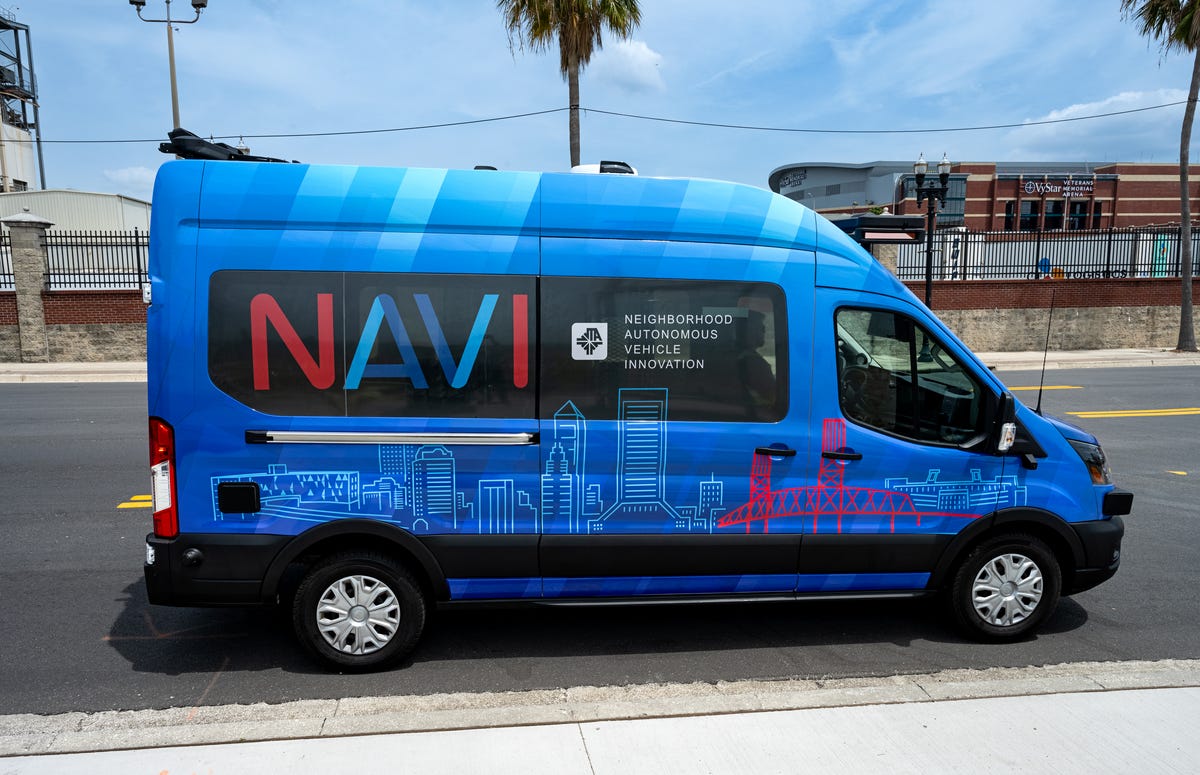
Shiny, right?
Now, I know what you’re thinking, isn’t that just a van? DART already does vans. We call them GoLink.

If you thought NAVI is a van, guess what? You’re right! It’s literally just a van!
But not just any van—it’s a driver-less van!✨
No driver? You know what that means—save money on operator costs! Those pesky human operators are the biggest cost of running any transit service; by removing them from the equation, the agency saves money while providing a high level of service. Efficiency!! 💸 Innovation!! ✨
But… there’s a catch… it may not have a human “driver”, but every NAVI has a human “attendant” who stays in the vehicle at all times. And sits in the driver’s seat with their hands close to the steering wheel ready to drive at any moment in case of an emergency or unexpected condition.
So, a driver-less van. With a driver.
So, just a van.

But wait, surely NAVI must have some ✨innovative✨ advantage over boring traditional transit like buses, trains, and… well… vans…
Aha! I know! NAVI is compact and nimble like a van, making it perfect for on-demand, door-to-door transportation! Just like GoLink! NAVI is micro-transit plus driver-less technology!! 💡
…right??
No.
NAVI is not on-demand, and it doesn’t pick up and drop off passengers at their door. It follows a fixed schedule on a fixed route along 1.75 miles by the bay, forming a 3-mile circuit in downtown Jacksonville.
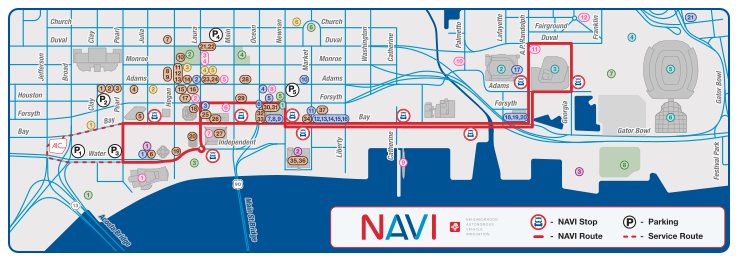
Y’know, like a bus.
Except, NAVI is not a bus that can carry 50 people or more at a time. Nor is it a streetcar that can carry up to 150 people, or light rail that can carry up to 274 people. It’s not a train that can link up to three cars on a single consist to carry over 750 people at once. It’s not a modern streetcar with fully-level boarding, allowing for efficient boarding of multiple wheelchair users and cyclists simultaneously. It doesn’t have exclusive guideway allowing it to fly past traffic.
NAVI is a Ford Transit van that can carry up to 12 passengers at a time; can get stuck in traffic; can accommodate wheelchair users and bicycles but only one at a time; and boarding wheelchairs and bikes takes extra long; and it runs on gasoline instead of electricity so vehicles need regular refuel breaks, not to mention the price of fuel.
There are no physical advantages of NAVI over any other type of transit vehicle.
It’s just a van…
…but hey! A van is way more comfy than a bus! NAVI is comfortable public transit!! This is perfect for people who want to get around downtown to enjoy everything the entertainment district has to offer after dark. No more sharing a bus with creepy strangers at 10:00 PM!
Now that’s what I call ✨innovation✨!!
Great thinking, there’s just a couple problems…


NAVI doesn’t operate past 7:00 PM, nor does it operate on Sundays and Saturdays.
Also, 4 out of 12 NAVI stops have been out of service all year due to downtown construction. Apparently, this ✨innnovative✨driver-less technology doesn’t work so well under imperfect conditions. Too bad downtown is in a constant state of construction, parades, planned protests, unplanned protests, block parties, parades, popup vendors, jaywalkers, cyclists, street performers, other crazy drivers…
Now you might be thinking: Why so few hours? Why so few stops? Why not extend NAVI’s hours and add more stops? One word—budget.
Okay, but doesn’t NAVI have ✨innnovative✨ and ✨efficient✨ driver-less technology that saves the agency money, allowing NAVI to run more often and more frequently? Well, if you haven’t caught on by now here’s the best worst part about NAVI: it’s ridiculously expensive.
Planners use a simple metric to calculate the subsidy per trip for a given route:
subsidy_per_trip = cost_per_day / (ticket_price x avg_daily_passengers)Notice how the more passengers a route serves per day, the lower the subsidy per trip.
Now, here’s the thing about NAVI—its cost per day is ridiculously high and the number of passengers who use it everyday is hilariously low.
For reference, the lowest performing DART bus routes have average weekday ridership between 191 and 338 trips. With recent budget cuts, multiple routes have been cut for having low ridership and high subsidy per passenger at around $30/trip.
Less than 89 people ride NAVI each day. If that sounds bad, it gets worse—an investigation found that JTA employees received an internal memo urging them to “sign up and ride (the NAVI) tomorrow and beyond” because “we are in dire need of riders. [frownie face emoji.]” Records revealed more than 50 employees, consultants and interns signed up to ride at least one two-and-a-half-hour shift. Some signed up for more than a dozen. More than 330 of JTA’s reported numbers are their own people working a shift. That averages to six of its 89 riders a day, almost seven percent of JTA’s reported numbers.
NAVI costs $1 million per month to operate, according to Action News Jax. For reference, the Dallas Streetcar—which faces its own share of scrutiny each year—costs $2.8 millon per year. Being 4x more expensive than a streetcar and carrying a fraction of the passengers…
NAVI’s subsidy per trip is $488
✨INNOVATION!!!✨ Transit!!! Yayyy!!! 🥳
I know the writing is starting to feel unhinged. But there are two more problems to address before we call it a night. First, a few of you might be thinking: Isn’t NAVI supposed to be more than vans? Aren’t there plans for actual autonomous pods?
Yeah, so what Nat Ford has been promising for years is a partnership with Holon USA to eventually replace NAVI’s Ford Transit vans with these “Holon Urban” vehicles.
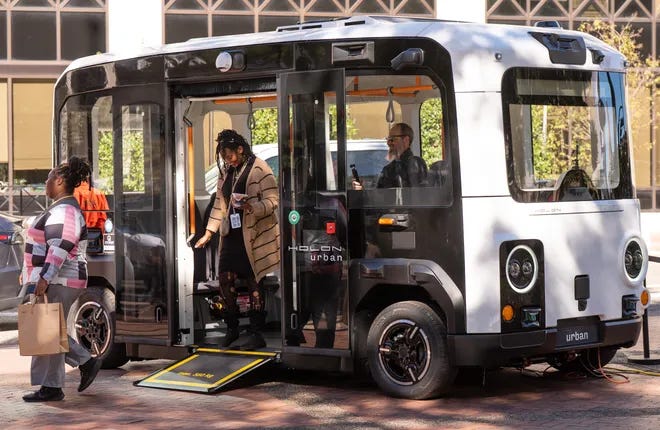
I’m not going to dive into the deeper rabbit hole behind the relationship between Nat Ford and the manufacturers of these vehicles. If someone else wants to do a write-up on that, by all means go for it.
To simplify matters, there are only two posssibilities: either JTA gets their fancy new pods, or they don’t. Frankly, after everything we’ve seen, combined with how there seems to be more bad news for NAVI every month, I’d honestly be surprised if NAVI survives past the end of the year, much less convert from vans to pods.
But suppose they do get the pods. Suppose, by some miracle, they manage to get this shiny, boxy, gadgetbahn vehicle operating in downtown Jacksonville for who knows how long. After the novelty wears off, what problem will it have solved that couldn’t have been solved by a more cost-efficient and effective mode of transport? Will that multi-million dollar wow factor be worth eliminating micotransit zones, cutting multiple bus routes, and reducing bus frequencies from 30 minutes to an hour?
And if, somehow, you stubbornly believe NAVI is genuinely innovative and Nat Ford’s crowning achievement just needs a little more time to prove itself, fine. Just ask yourself this: if NAVI is secretly a success that just needs more time, why did Nat Ford choose now to leave JTA for DART?
That is what scares me about this hire.
After choosing to live car-free in Dallas almost five years ago, I got into transportation advocacy after I realized life in our city could be even more wonderful if it were just a little more walkable. I’ve poured countless hours, days, weeks, and months of my life into supporting DART and advocating for better public transit because I know from first-hand experience how transformational it can be in people’s lives. Advocating for DART has always been about advocating for people.
But if we turn DART into one man’s escape route from the problems he created for himself in Jacksonville; if we pay this man more than half-a-million dollars every year to turn our city into his personal playground; and if we prioritize ✨innovation✨ over improving the lives of everyday people, then I honestly don’t know I’m advocating for with DART.
…
I mean, don’t get me wrong, I won’t give up on advocating for Dallas public transit if Ford gets hired. But man, it will be a hell of a lot more difficult. We deserve better.
Click here to find contact information for the DART Board of Directors, and click here for information on upcoming board meetings, including the Special Called Meeting on Tuesday, July 21st.
If you’re not a public transit advocate, you’re not an urbanist. Full stop.
You can’t just advocate for urbanism when you get everything you want.
This reminds me of Paul Wageman the DART director with lobbying ties to Uber. And thought I don’t mind the use of UBER with GoLink as it has saved me ALONGSIDE DART van drivers when I got in a car accident this year I know we can do better. I just wish we’d learn by now.
On days I do choose to drive I’m horrified to drive next to a Waymo with all these controversies. I had a Waymo cut me off the other day on my way to work. No blinker. It’s pretty dystopian to read this. The article isn’t unhinged, I think it’s reasonable.
I do hold some hope with people crying about the DART budget being misused across the metro I pray we as a whole don’t allow anything remotely like this. The DART van that occasionally picks me up doesn’t even have AC... ):
I have some terrible anxiety but I feel like I need to attend these meetings. Thanks for sharing and keeping people like me informed.